
Christmas with Elvis (EPA-4340): The 1958 Christmas EP that kept the Presley phenomenon alive during his time in the Army
What is “Christmas with Elvis” and why does it matter?
“Christmas with Elvis” is an extended play (EP) that compiles four Christmas performances by Elvis Presley from his classic holiday repertoire. Cataloging this EP, it is usually identified as RCA Victor 45 EP EPA-4340, and serves as a bridge between the Christmas album phenomenon and the market for short-form formats that dominated impulse buying.
The official discography on Elvis’s music website presents it as an EP that compiled “the last songs from the Christmas album that had not yet appeared in EP format” and attributes it with sales of approximately 80,000 copies.
Its historical significance is not limited to Christmas: the EP is part of the industrial machinery that kept Elvis’s name circulating for years of high demand and helped solidify the idea of ??“Elvis as a seasonal tradition,” a phenomenon that grows over time and is revived every December.
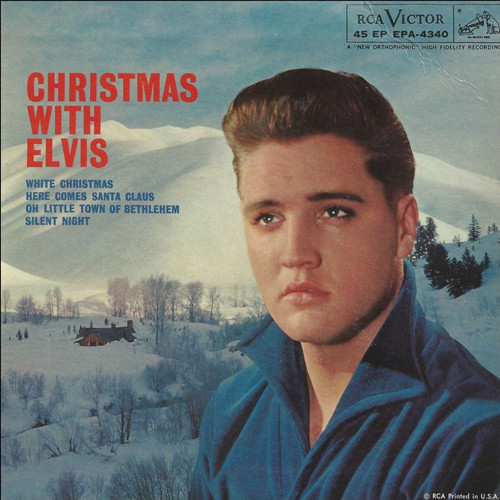
Edition date: September 1958 vs. published release date
Edited and distributed to stores in September 1958 (according to Graceland), with a release date listed as October 13, 1959 in the official discography.
Context: Elvis in the Army and the RCA strategy
1958 was a turning point: Elvis joined the Army, and his career machinery was reconfigured to maintain public presence and sales without regular promotion. Graceland explains that, while Elvis was serving, RCA and Colonel Parker managed releases to keep him on the charts and in the cultural conversation.
In this context, a Christmas EP made sense for two reasons: first, because Christmas music has an annual demand cycle; second, because the EP format was a quick way to consume music, ideal for buyers who didn’t need (or couldn’t afford) the full-length album. The official website itself describes how the Christmas album continued to sell strongly in its second season, reinforcing the incentive to “fill in” what was missing on the EP.
Thus, “Christmas with Elvis” is not just another title: it’s a clear example of how Elvis’s catalog became a living system, capable of rearranging existing recordings to respond to specific commercial windows, in this case, the last quarter of the year.
EP tracks: selection and musical structure
The official tracklist of the EP includes four classics: “White Christmas,” “Here Comes Santa Claus (Right Down Santa Claus Lane),” “Oh Little Town of Bethlehem,” and “Silent Night.” The selection balances popular (secular standards) with liturgical (traditional Christmas carols), broadening the EP’s appeal to households with diverse sensibilities.
In “White Christmas” and “Here Comes Santa Claus,” Elvis employs warm and direct phrasing, designed for familiarity: songs that serve as an “entry card” even for those who weren’t regular rock and roll fans. In the official discography, both are listed alongside the EP “Christmas With Elvis” (1959) and are contextualized as part of the Christmas package derived from the album.
In “Oh Little Town Of Bethlehem” and “Silent Night,” the solemn aspect is reinforced: Elvis reduces the rhythmic emphasis and prioritizes the devotional character, something that helped normalize his presence in a traditional repertoire that, in the late 1950s, was still closely watched by certain sectors. The official liner notes identify these tracks within the EP and link them to the Christmas sessions of his classic repertoire.
Recordings: dates, authors and musicians
The official liner notes for Elvis’s recordings detail that several of these performances were recorded in September 1957 at Radio Recorders (Hollywood). For example, “White Christmas” is listed as having been recorded on September 6, 1957, and credits musicians such as Scotty Moore, Bill Black, D.J. Fontana, and Dudley Brooks, as well as backing vocals by Millie Kirkham and The Jordanaires.
“Here Comes Santa Claus (Right Down Santa Claus Lane)” is also listed as having been recorded on September 6, 1957, at Radio Recorders and with the same core accompaniment, which lends sonic coherence to the whole and suggests a session planned to create a Christmas block that could be reused in different formats.
In the case of “Oh Little Town of Bethlehem,” the official liner notes indicate a recording date of September 7, 1957, at Radio Recorders (Hollywood), and it maintains the same instrumental/vocal foundation. For “Silent Night”, the official information associated with the Christmas repertoire places the recording on September 6, 1957 with the same musical team, reinforcing the idea of ??a compact and highly exploitable session package for publishing.
Legacy: performance, collectability and value on an Elvis website
In commercial terms, the official website notes that the EP was not a sales “blockbuster” (80,000 copies are cited), but contextualizes the data as part of a larger phenomenon: Elvis’s Christmas catalog was consolidating itself as a seasonal standard, with the ability to sustain sales year after year.
For collectors, “Christmas with Elvis” stands out for three reasons: it features a specific selection of four songs, it fits into the narrative of Elvis’s time in the Army (with distribution to stores in September, according to Graceland), and it aligns with the “EP as a capsule” publishing model, expanding on what the public already knew of his Christmas repertoire.
This EP works particularly well as evergreen content: it becomes relevant again every holiday season, and it allows for a connection between history (1957–1959), biographical context (military service), and official discography (tracklist and liner notes) without relying on specific anniversaries.
Explore our complete Elvis discography with detailed sheets, galleries, and analysis. View discography